

Ramadan, the ninth month of the Islamic lunar calendar, may be 29 or 30 days long. An Islamic month begins with the sighting of the new crescent in the western horizon, immediately after sunset. Muslims look toward the western horizon for the new moon on the 29th day of Shaban, the eighth month. If the new moon is sighted, Ramadan has begun with the sunset but fasting begins with the next dawn. If the new moon is not sighted on this 29th day, Muslims complete 30 days of Shaban and Ramadan begins the following day.
The Significance of Ramadan and Fasting:
Allah says in the Quran:'O you who believe! Fasting is prescribed for you, even as it was prescribed for those before you, that you may attain God-consciousness. (2:183)
"In the month of Ramadan, the Quran, a book of guidance with proofs of guidance distinguishing right from wrong, was revealed. Therefore, whoever of you is present in that month let him fast. But who is ill or on a journey shall fast a similar number of days later on. Allah desires your well-being, not your discomfort. He desires you to fast the whole month so that you may magnify Him and render thanks to Him for giving you His guidance." 2:185
Accordingly, the month of Ramadan is called the month of the Quran; therefore, Muslims have tradition of reciting Quran frequently in this month.
Sawm or Fasting:
Sawm means a fast that begins with dawn and ends with sunset. Muslims rise before dawn, eat Suhur (pre-dawn meal) and drink liquids for the preparation of Sawm (fasting). Eating and drinking stops at dawn. During the day no eating, drinking or sexual activity is allowed. In addition, a Muslim must adhere to the moral code of Islam very strictly as failure violates the requirements of fasting.
Fasting in the month of Ramadan is one of the deeds of worship required of all Muslims who have attained puberty. Women who are having their menstrual period or who have not fully recovered from childbirth, postpone the fast until they are completely out of their special conditions. In addition, those who are ill or in travel may choose to postpone their fast.
Muslims fast because Allah has commanded them to do so. However, they may also think about the benefits of fasting which may include developing control over hunger, thirst and sexual urges, training to be a good moral person and, testing sincerity to the Creator. During the fast, Muslims may conduct their business as usual. However, in the Muslim countries working hours are shortened by a couple of hours a day and the hours are changed to make the work comfortable.
The fast is broken immediately after sunset, usually by eating dates and drinking water or juice. However, any lawful food or drink may be used to break the fast. This is followed by the Maghrib salah (after sunset prayer) which is followed by a complete meal. After a brief rest, Muslims go to the mosque to offer the Isha salah (night prayer) and then a special night prayer, called Taraweeh.
Taraweeh:
This nightly congregational salah (prayer) is performed after the Isha salah. Traditionally, a Hafiz of the Quran, a person who has memorized the whole Quran which is in Arabic, leads the prayer. He recites the Quran in small portions, in proper sequence, every night and completes the recitation of the whole Quran before the end of the month of Ramadan. Every Muslim who attends such prayers regularly gets the opportunity of listening to the whole Quran in a month. If a Hafiz of the Quran is not available, the Muslim who has memorized the most in a group leads the prayer and recites according to his ability. In the absence of a Hafiz, some Muslims hold the Quran in the hand during their salah and read from it. Some Islamic scholars cite the report of the Prophet (p.b.u.h.) that, with the exception of three nights in one Ramadan, he always prayed during the night in his house whether it was Ramadan or not.
Ramadan Generosity:
The month of Ramadan brings many blessings multiplied manifold for those who do good. During this month people are more generous, more cordial, more friendly and more ready than other times of the year to do good work. The poor and the needy receive food, clothing and money from the well-to-do in the community. Many people go to the mosque in the neighborhood for fast breaking and meals. People in the neighborhood send fruit, food and drinks to the mosque - the atmosphere is that of a friendly pot luck dinner every evening of the month.
Well-known philanthropists of the Muslim community find themselves surrounded by the needy people and Islamic workers for donations. Zakat, a wealth purifying tax, and donations are given at this time of the year since many Muslims wish to take the opportunity of multiplied rewards from Allah.
Laylat al-Qadr:
This is the night of the Qadr. The term Al- Qadr has been frequently translated as "the power". A better translation may be "the value" or "the decree" because Allah says the value of this night is better than one thousand months, a life time of over eighty-three years. Allah sends His decrees at this night. This is the night when the Quran was revealed. Allah says in the Quran:
"We have indeed revealed this (the Quran) in the Night of Value (or Measure). And what will explain to you what the Night of Value is? The Night of Value is better than a thousand months. Therein come down angels and the Spirit (the angel Gabriel) by Allah's permission with all decrees. (That night is) Peace until the rising of the dawn." 97:1-5
The night of value is a gift to mankind from Allah. However, it is not clear which night is Laylat al-Qadr. Some reports by companions of the Prophet (p.b.u.h.) elude it to be the 27th night of the month of Ramadan, but many more sayings point to any of the odd date nights during the last third of the month of Ramadan. According to authentic teachings of the Prophet Muhammad (p.b.u.h.) Muslims are advised to spend the 21st, 23rd, 25th, 27th and 29th nights of Ramadan in worship and doing good works to assure finding Laylat al-Qadr. A portion of the Muslims stay up all night in prayers and good works, however, the Prophet (p.b.u.h.) and his companions used to sleep at least one-third of the night.
In Muslim countries, the 27th of Ramadan is a holiday to enable people to rest during the day after all night of worship. Schools are closed from the 27th of Ramadan through the 2nd of Shawwal (5 to 6 days) to combine Laylat al-Qadr and Eid al-Fitr observances.
I'tekaf or Seclusion:
The practice of the Prophet Muhammad (p.b.u.h.) was to spend the last ten days and nights of Ramadan in the Masjid (mosque). Following his practice, it is considered a community duty that some people go in I'tekaf (seclusion) in a neighborhood Masjid. The people in I'tekaf spend their time in various forms of Dhikr (remembrance of Allah), such as doing extra salah, recitation and study of the Quran, study of the Hadith, repetition of some phrases of praise and glory to Allah, exhorting each other to be good through obeying Allah and His Messenger (pbuh). Since people in I'tekaf are not permitted to go outside the Masjid except for emergencies, they sleep in the Masjid and use available facilities of the Masjid. The food for the people in I'tekaf is provided either by their own families or people in the community. I'tekaf is terminated, generally, at the declaration of sighting of the moon or the end of the month of Ramadan. For busy people a shorter version of I'tekaf is allowed, such as one night, one day or a few days.
Sadaqat al-Fitr:
In general, any material help extended to the poor, needy and to those who ask and deserve is called Sadaqah. Sadaqat al-Fitr, which is also called Zakat al-Fitr is the obligatory material help extended to the poor of the society before the Eid prayers, preferably to be given early enough for the poor to prepare for the celebration. In North America, the estimated amount is $5 to $8 to be given on behalf of each member of the donor's family, including infants.
Eid al-Fitr:
The end of the fasting month is celebrated on the first of Shawwal, the 10th month, which follows Ramadan. Traditionally, on the 29th of Ramadan after sunset, people go out in the open looking for a new crescent in the western horizon where the sun sets. If the crescent is sighted, the end of Ramadan and Eid are declared. If the crescent is not sighted, Ramadan is extended by one day.
On the day of Eid, people take a bath or shower in the early morning, eat breakfast, wear their best clothes, apply perfume and proceed to the place of Eid congregation while pronouncing takbeerat, saying, "Allah is the Greatest, there is no deity but Allah and all praise belongs to Allah." Muslims pronounce takbeerat in their homes, streets and place of congregation while waiting for the leader, Imam. It was the practice of the Prophet Muhammad (p.b.u.h.) to hold Eid prayer congregations in open grounds. Following the practice of the Prophet(s), Muslims are advised to hold Eid prayers in open grounds. In the Muslim countries with warm climate there are designated Eid prayer grounds. However, in North America Muslims rent halls at convention centers or major hotels.
The Imam rises at the appointed time, leads the prayers and delivers a khutbah, sermon. At the end of the sermon, people supplicate, greet, embrace and congratulate each other for the successful completion of Ramadan and ask Allah for the acceptance of their efforts in His obedience.
During the day, people visit each other and children may receive gifts. In some countries, people go for picnics and other gatherings. In addition, special Eid celebrations may be arranged at work or in social settings. Essentially, Eid is a day of thanks to Allah, and also a gathering of family and friends.
Umrah or Minor Hajj in Ramadan:
There is a report from Prophet Muhammad (p.b.u.h.) saying that performing Umrah in the month of Ramadan is equal to performing a major or complete Hajj. Hajj is a pilgrimage to Makkah (commonly misspelled as Mecca). Hajj is the enactment of some of the trials and tribulations of Prophet Abraham (A), his wife Hjir (Hagger) and his oldest son, Isma’il (A) (Ishmael). Hajj includes the sacrifice of Ishmael, represented by the sacrifice of an animal, such as ram, goat, sheep, cow or a camel. Complete Hajj lasts for five days but Umrah is completed in a couple of hours. Umrah is only a small part of the Hajj. An animal sacrifice may be offered at the completion of Umrah. Umrah may be performed anytime during the year but it has special significance in Ramadan. Hajj is performed only during the 8th and 13th days of Dhu al-Hijjah, the twelfth month of the Islamic calendar.
By: Dr. M. Amir Ali, Ph.D
Source: www.ilaam.net
Saturday, September 6, 2008
Ramadan And Fasting

Ramadhan the Fasting month
Sallam all,
As we are witnessing the fasting month now i.e. Ramadhan, I would like to update this blog with some useful information related to Ramdhan, the aim behind fasting, the benefits behind fasting and more information related to fasting.
I hope the information will be of a place of assessing and understanding the concept behind fasting, and reassuring the knowledge built previously to those who are already aware of this month and the act that we have to perfume during the holy month.
Sunday, August 31, 2008
Ramadhan Kareem to all Muslims

Monday, December 24, 2007
Hajj Knowledge - 4 (final post in this topic)
- Wearing Ihram from the Miqat.
- Spending a day at Arafat.
- Spending the night in Muzdalefah.
- Staying in Mena (the days of Tashreeq).
- Casting at the Jamarat.
- Shaving off head or shortening the hair.
- The Farewell Tawaaf.
For missing one of these compulsory acts, one must offer a sacrifice of an animal, slaughtered in Haram area and distributed among the poor and the needy of the Haram. He/She mustn't eat from it and his/her Hajj is correct. It is not permissible to leave any act on purpose.
Things Forbidden on a Person While in the State of Ihram:
- Things forbidden on both men and women:
1.Removing hair from any parts of one's body.
2.Trimming of nails.
3.Using perfumes (avoid scented soap).
4.Physical sexual contact with the spouse with or without intercourse.
5.Wearing gloves.
6.Hunting (land) animals.
7.Contracting marriage or proposing for potential spouse, neither for you not for others. - Things forbidden on men; not women:
1.Wearing of sewed clothes.
2.Covering the man's head with anything that touches the head (umbrellas are ok.) - Things forbidden on women only: Wearing veils with holes for the eyes (Niqab) or Burqa. The Sunnah is for her to uncover her face except if men not related to her might see her. In such case, it is obligatory for her to cover her face during Ihram and otherwise.Whoever performs any of these violations of Ihram due to forgetters, ignorance or by compulsion, he or she is not charged with expiation except hunting, here Fidyah (Kaffarah) is compulsory.
Visiting the Prophet’s Mosque:
Note:
There are no other mosques or places in Madinah, which are to be visited. Therefore, do not burden yourself by visiting places for which there is no reward or for which, in fact, there might be some blame for doing so.
By this, the hand book has been concluded.
At the end, I ask Allah that this hand book to be of great benefit and make it with sincerity.
With the end of this topic i pray for every one to be blessed and forgiven by Allah [swt] and that for those who are already in hajj to return home safe and peacful, and for those who are not gone yet to hajj to be written for them to perform hajj soon insha-Allah and be in good health and wealth.
Tuesday, December 18, 2007
Hajj Knowledge - 3
Actions to be Done on the 8th Day of Dhul Hejjah:
- Staying overnight at Mena this day (from the sunset of the eighth day of the Dhul Hejjah until the near Fajr (dawn) of Arafa day appears).If you are performing Hajj Tamattu, go into the state of Ihram morning or noon from the place where you are staying in Makkah. It is good for you to purify yourself by bathing, perfuming and wearing a two –piece unstitched clean white garment. And then intend for Hajj and say: "labbaika Hajjan". Which means: "I am here for Hajj". Then you say "Labbaika Allahumma Labbaika, Labbaika la Shareeka laka labbaik, innal Hamda Wanni'mata Laka Wal Mulk, Laa Shareeka Lak". Which means: "Here I am for Hajj- here I am, Oh Allah, here I am, there is no partner for you, Here I am! Surely, all praise and blessings are for you and dominion is yours. There is no partner for you". For Qarin and Mufrid, they are still in their previous state of Ihram. They start directly Talbiyah "Labbaika Allahumma Labbaik…etc". from the morning of the day.
- Leave for Mena in the morning and perform Dhuhr, Asr, Maghrib, Isha prayers (Dhuhr, Asr and Isha are each shortened to two Rakats (units) only but are not combined). Then perform Fajr prayer of the ninth day.
- Soon after the sun rises leave for Arafat.
Actions to be Done on the 9th Day of Dhul Hejjah:
1. The standing (wuqoof) in Arafat
The standing (wuqoof) in Arafat is one of the most fundamental rites of Hajj and the prophet PBUH said: "al Hajj Arafah". Which means: "Hajj is Arafah".Its time:
a) The best: from the afternoon till after the sunset.
b) The permissible: from the dawn of the 9th day till the down of the 10th day. If you have spent even a few minutes in Arafat, your Hajj is correct. But if your attendance occurs before the sunset only, you are charged for a compensatory animal. Even these minutes take place after sunset, you are not charged with an expiation, but you have missed sleeping in Muzdalefah. In this case, you are charged for an animal for Muzdalefah and not for Arafat.
- Soon after the sunrise, leave for Arafat and perform Dhuhr and Asr prayers (combined and shortened during the time of Dhuhr with one Athan/Adhan and two Iqaamahs – and stay there until the sunset. Invoke Allah as much as you can and it is from Sunnah to face Al-Qibla during supplication and not facing the Mountain of Arafat. It is preferred to say this supplication: "Laa ilaaha illaallahu Wahdahu laa Shareeka lahu- lahul mulku wa lahul hamd- Wa huwa 'alaa kulli shai'en qadeer". Which means: "There is no deity worthy of worship except Allah, the One without a partner. The domain and the praise are His, and He is powerful over everything".
- All of Arafat is a place for standing. Ascending the mountain of Arafat in not permitted. It is preferable to invoke much supplication. It is not necessary to keep standing or say under the sun, you are free to sit and to be sheltered.
2. Leaving Arafat for Muzdalefah:
a) When the sun has set, go to Muzdalefah. When reaching it, pray Maghrib and Isha (combined and shortening the Isha prayer to two Rak'ah with one Adhan and two Iqamahs) before reclining and collecting pebbles.
b) Stay overnight in Muzdalefah to perform the prayer of Fajr (down prayer) and keep busy supplicating waiting for the brightness of the morning is widespread. (Sleeping in Muzdalefah is compulsory) but weak individuals and women are allowed to proceed to Mena at any time after midnight, after the moon has completely disappeared to avoid the crowd.
c) Collect seven pebbles for stoning the Jamarat – ul Aqaba (a stone pillar in Mena). Any place you collect pebbles from is permissible.
d) Leave for Mena before the sun rises.
Actions to be Done on the 10th Day of Dhul Hejjah:
- It is preferable to make Du'aa after Fajr till the brightness of the morning is widespread.
- Leave for Mena to stone the Jamrat – ul –Aqabah (a stone pillar in Mena) and slaughter an animal or go to Makkah to perform Tawaf-ul –Efaadhah. But shaving can be done in any place.
- Stoning of Jamrat –ul – Aqabah: Stone the Jamrat –ul-Aqaba (it is the nearest one to Makkah) with seven consecutive pebbles glorifying Allah " Allahu Akbar" which means: "Allah is the Greatest" as you throw each pebble.
- Slaughtering of Sacrifice: Slaughter the sacrificial animal (hady); eat some of it and distribute it among the needy. Slaughtering an animal is compulsory on Mutamatte and Qarin while for Mufrid it is preferred.
- Shaving the head or Trimming: Have your head shaved or trimmed but shaving is better. (a woman can cut a finger tip length of her hair).
- If you have done stoning and shaving, you end the first phase of the state of Ihram (this is called the first Tahallul). It is also ok if you do two out of four e.g. stoning or shaving or Tawaaf and Sa'yi. (Slaughtering is not included because it is not compulsory for all pilgrims). If you do these four things completely with slaughtering (if it were compulsory), you end the second phase of the state of Ihram (this is called the second Tahallul).First Tahallul means: You can wear other clothing and do everything that was lawful before Ihram except physical contact with the spouse (with or without intercourse or kissing and so on).Second Tahallul means: Everything that you were prohibited from (by Ihram) has been allowed for you even women (sexual intercourse).
6. Tawaaf–ul-Efaadhah: Go to Makkah and perform Tawaaf–ul–Efaadhah (Tawaaf al-Hajj). If you have removed Ihram, circle in clothes you wear.
7. Perform Sa’yi of Hajj: If you are Mutamatte or Qarin and you did not perform the Sa'yi before with Tawaaf ul-Qudoom (the Tawaaf of Arrival), it is permissible to delay Tawaaf–ul–Efaadhah and the Sa'yi Hajj until the 13th day. But the state of Ihram can not be lifted without doing them.
8. Sleeping the days of Tashreeq in Mena: (it is meant by sleeping here to spend the night – even a part f its time – in Mena whether awake or walking and it is not necessary to sleep).
Actions to be Done on the 11th, 12th and 13th Days of Tashreeq:
1. Stoning Jamarat during the days of Tashreeq: (The way of stoning): After the decline of the sun, throw pebbles at the three Jamrats, starting from the smaller one (the furthest one from Makkah), the medium one and the biggest alternatively. Throw seven pebbles at each Jamrat, glorifying Allah "Allahu Akbar" with each throw and perform much du'a (supplicate) with raised hands after the smallest and medium Jamrat and don't stop after Jamrat–ul-Aqabah.
2. Sleeping in Mena these days, as it is mentioned on the 10th day.
3. If you complete stoning on the 12th, and you want to leave earlier, leave Mena before the sun sets. If the sun sets before you are able to depart, remain in Mena on the 13th day and stone the three Jamrats early afternoon of that day.
4. Farewell Tawaaf:It is the final rite of Hajj.
If you want to go to your country, circle the Kaaba seven times (Tawaaf al Wadaa) (farewell Tawaaf) in your clothes. And you have to leave Makkah.
Otherwise if you stay, you have to repeat Tawaaf.(A menstruating woman or a woman having postnatal discharge would be exempted from Tawaaf al Wadaa).
The Fundamental Rites of Umrah:
- Entering the state of Ihram.
- The Tawaaf.
- The Sa'yi.
- Wearing Ihram from Miqat.
- Shaving or Trimmning.
The Fundamental Rites of Hajj:
- Entering the state of Ihram.
- Standing in Arafat.
- Tawaaf (Tawaaf-ul-Efaadhah).
- The Sa'yi (hasten between the hills of Safa and Marwah).
* Missing any of these pillars, his/her Hajj will not be completed until he/her performs it.
Friday, December 14, 2007
Hajj Knowledge - 2
- (For a man): Take off all the stitched garments to have a bath as you would do after sexual intercourse and perfume your head and beard with the best oil you can find –there is no harm in what remains of it after Ihram. Don’t perfume the Ihram garments.
- Wear yourself from below the chest with white fabric (izar) and drape another piece over your two shoulders (ridaa) except in every Tawaaf, the right shoulder should be exposed.
- (For a woman): Ihram is her customary stitched garments. She avoids wearing perfume or the type of dress which attracts attention. She isn’t abiden by a certain color. Pray the prescribed prayer if its stated time is on. And then offer two Rakats (Units) of prayer as a Sunnah act of Ihram. (There is no harm if you don’t pray it).
Then if you ride the car, intend the Nusuk and then say according to your Nusuk:
1- If you want to perform Umrah only, you say: “Labbaika Umrah” which means: I intend to perform Umrah”.
2- If you want to perform Hajj only (Ifrad) you say: “Labbaika Hajjan”. Which means: “I intend to perform Hajj”.
3- If you want to perform Hajj and Umrah together in their actions, you say: “Labbaika Omratan Mutamattean biha ilal-Hajj” which means: “I intend to perform Hajj and Umrah”.
4- If you want to perform Hajj and Umrah in the actions of Hajj (Qiran), you say: “Labbaika Omratan wa Hajjan”. There is no need to repeat these utterences three times but only one time is enough.
Notes:
1. Each Nusuk (type) has its own benefit.
2. There are variances between them in intention, utterances and actions.
3. The best: Tamattu, then Ifrad, then Qiran.
4. For (Qiran): A female pilgrim needs it if she wants her Ihram as Mutamatt'eh and she couldn't accomplish her Umrah incase her menses comes as well as for the one who comes late and fears missing standing in Arafat;also, who is detained to enter the Holy House for any reason.
If you fear that anything may detain you from completing your rites due to sickness or regulation procedures, you can make your intention conditioned in state of Ihram by saying: "Allaahumma Mahallee Haithu Habastanee"which means: "O Allah my place is wherever you prevent me". But if you don't fear any thing, it is not permitted to make your intention conditioned. Its benefit is: If you are prevented by any obstacle, you are excused legally to terminate your Ihram and return and you are not charged with an expiation.
Then you start Talbiyah:
"Labbaika Allahumma, Labbaik, Labbaika laa shareeka laka labbaik. Innal-Hamda wanni'mata laka wal mulk La shareeka lak".
Which means: Here I am, O Allah, here I am, there is no partner for you, Here I am! Surely, all praise and blessings are for you and dominion is Yours. There is no partner for you.
A man raises his voice when saying it and a woman says it so that only one beside her may hear her).
Saying Talbiyah in groups are not permitted and each Muhrim makes Talbiyah alone and continues saying it till he/she reaches the Holy House.
The supplication: "Allahumma inni Urid-ul-Umrata fa yassirha li wataqabbalaha mini. Labbaika Allahuma labbaik, Labbaika la shareeka laka labbaik, Innal-Hamda wanni'mata laka wal mulk, La shareeka lak".
Which means: "O Allah, I intend to perform Umrah, so make it easy for me" Here I am for Umrah-here I am, oh Allah, here I am, there is no partner for you, there I am! Surely, all praise and blessings are for you, and dominion is yours. There is no partner for You. And "Allahumma inni as'aluka ridhaka wal-Jannata waa'udhu bika min sakhatika wan nar".
Which means: "O Allah! I beseech You grant me Your pleasure and Paradise, and I seek your protection from Your Wrath and Hell-Fire". Saying such specific supplications is not necessary but you can say what you like. Also, praying on the prophet (pbuh) is not mentioned in this place.
It is permissible on the way to glorify Allah "Allahu Akbar" whenever you mount a hill and praise Allah whenever you descend in a valley.Then you return to the General Talbiyah "Labbaika Allahumma labbaik"…etc. until you reach the Sacred House.
2- Go to the Holy Mosque for Tawaaf:
- When you approach the Holy Mosque say: "Allahu Akbar".
- Then cease Talbiyah and go to the Sacred House.
- When you enter the Sacred mosque, place your right foot and say "Bismillah wasalat wasalam Ala Rasul Allah Allahuma Ighfir Li Dhunoobi waftah li Abwaba Rahmateka". Which means: "In the name of Allah. May peace and blessings be upon Rasoolullah, O, Allah! Forgive my sins and open for me the gates of Your mercy". Or: "Aoudhu Biwajhika Al Azeem Wa Sultanika Al-Qadeem min Al-Shaytanir rajeem". Which means: "I seek refuge in Allah the Al-mighty, and in His noble countenance and in His eternal power from Satan the Rejected".
- Then head for the Hajr-Al-Aswad (the sacred Black Stone) to start Tawaaf (circling it). Touch it with your right hand and kiss it. If you can not kiss it, it is enough to touch it by your hand only. If you can't do so, touch it by a stick or another thing and don't kiss it. If it is not possible, make a sign towards it by your right hand without kissing it.
- You had better not push Mutamereen (visitors of the Holy Mosque) and crowd to get it. Keep the Kaaba on you left side. In the meantime, you should drape the upper cloth (Ridaa) over the left shoulder and leave right shoulder exposed which is called in Arabic (Idtiba). And say whenever you reach the Black Stone: "Bismillahe wallahu Akbar". Or "Allahu Akbar" only. Which means: "In the name of Allah and Allah is the Greatest. " or" Allah is the Greatest".
- Move quickly in the first three rounds (in case it is easy. You may not to do so with the crowd); walk normally in the other four. This is for Tawaaf-ul-qudoom only.Supplicate and say between the two Rukns (al-Rukn Al-Yamani and the Black Stone): "Rabbanaa atina fiddunyaa hassanatan wa fil akhirati hassanatan wa qinaa adhaban-naar wa adkhilnaal-jannata ma'al abrar, ya'Aziz ya Ghaffar ya Rabbal 'alamin". Which means: "Our Rabb! Grant us good in this world and hasanah in the Hereafter and protect us from the torment of the Fire.Each time you pass the Black Stone say: "Bismillah wallahu Akbar". Which means: "In the name of Allah, Allah is the Greatest". You can supplicate what you like during the rest of Tawaaf. Invoke to Allah or recite some verses of the Holy Quran…etc. There is no specific supplication for each round.
- Having completed the seven rounds, go to Maqam Ibrahim (Ibrahim Station) and recite: "Wattakhidhu min maqami Ibraheem Musalla" Which means: "And take the station of Ibrahim as a place of worship" and perform two Rakats (units) behind the Maqam (close to it if possible or at any place in the mosque). Recite after "Sura al-Fatihah" "Sura al-Kafirun". (say, "O disbelievers", in the first Rakat (unit) and Surah "Al-Fatiha and "Sura al-Ikhlas": "He is Allah (who is) One" in the second Rakat (unit). (There is no harm if you recite other Surahs).
- Go to Zamzam: Drink from it and praise Allah.
3- Proceed to As Safa for Sa'yi:
- Ascend to As Safa hill until you face the Ka'bah and raise your hands and glorify Allah (three times) and say:"Laa ilaaha illaallahu wahdahu laa shareekalahu-lahul mulku wa lahul hamdu – wa huwa 'alaa kulli shai'in qadeer. Laa ilaaha illallahu wahdahu-anjaza wa'dahu wa nasara abdahu wa hazamal ahzaaba wahdahu". (three times). Which means: "there is no God but Allah, He has no partner, Sovereignty belongs to Him and praise too, He Fulfilled His promise, Helped His servant and routed the hosts, all Alone".
- Then recite: "Inna as-safa wal-Marwata min sha'airillah faman Hajj-al-baita awi'tamara falajunahha 'alaihi an-yatawafa bihima, waman tatawwa'a khairan fainnallaha Shaakeran 'Alim." Which means: "Behold! Safa and Mahwah are among the symbols of Allah. Whoever visits the Sacred House for pilgrimage or Umrah should walk to or fro between them. And if anyone obeys his own impulse to good, be sure that Allah is He who recognizes and knows" 2: 159. This verse is to be read at the first round only. It is preferable to start with before any Dhikr, and you may supplicate to Allah the way you like in this place and raise your hands.
- Then descend towards Marwah till you reach the green signpost. Then walk fast till you reach the next green signpost. Then walk fast till you reach the next green signpost saying: "Rabbighfir warham watajawaz ama ta'alam innaka antal a'azzul akram"Which means: "O Lord forgive and have mercy, verily you are the Most Mighty and Most Noble".Walk at a normal pace before and after them. (Walking fast is only for men) (women are not permitted to run). You may supplicate during Sa'yi what you please and there is no specific supplication for each round.When you reach Marwah, do the same as you did in Safa except for reciting the above mentioned Sura. It is to be read at the first round only. Repeat the lap seven times.(Going from As-Safa to Marwah is a lap and returning is another lap).
- Upon completion the hasten (Sa'yi), have your head shaved or trimmed but shaving is preferable. If your coming to Makkah is very near to Al-Hajj period, in this case trimming is preferable in order to shave your head in Hajj. (A woman can cut a finger –tip length of her hair).
- Remove your Ihram and resume your normal life.
In this way, you have performed full Umrah; if you want it separate or you want it for Hajj, in case you are Mutamatte But If you are Mufrid for Hajj or Qarin, you intend Tawaf- ul-qudum- it is Sunna- and Sa'yi for Hajj – is a fundamental rite-; keep in state of Ihram and don't remove it. Don't shave or trim till the 8th of Dhul Hijjah to complete the rest of Hajj actions.
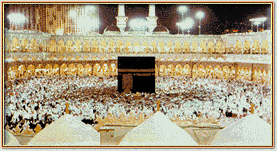
Hajj Knowledge - 1
Sallam,
As we are in the season of Hajj i.e. pilgrimage and it is the most sacred month to every one next to Ramadhan.
I thought of sharing some information in here to enlighten those who are not aware of the Importance of this month.
---------------------
Some Virtues of Hajj and Umrah
- The Prophet (pbuh) said: “Umrah is an expiation for the time between it and the previous ‘Umrah’ and an accepted Hajj has no less a reward than Paradise”. (Narrated by al-Bukhari 1683, Muslim 1349).
- The Prophet (pbuh) said: “He who performs Hajj and does not speak obscenely or commit evil then he returns just as the day his mother gave birth to him” (Narrated by Bukhaari, Ahmed, Nasai and Ibn Majah from Abu Hurairah).
- The Prophet (pbuh) said: “There is no day on which Allah frees more of His slaves from Fire than the Day of Arafah.” (Narrated Aisha, Ummul Mu’minin).
- The Messenger of Allah (pbuh) was asked which deed is the best? He said, “Belief in Allah and His messengers. He was asked, then what? He said, Jihad for the sake of Allah. He was asked, then what? He said, Hajj Mabrour (an accepted Hajj).” (Narrated by al-Bukhaari 26).
Types (Nusuk) of Hajj are Three:
Monday, December 10, 2007
Links to Quran in MP3 and Search
Sallam,
If any one is looking to download Quran in MP3 format then please click on the link below:
MP3 Quran
If any one is looking to find analysis, definitions of words, ayah and surahs in the Quran then click on the link below:
Quran Search
I hope it will Serve every one in good will.
Tuesday, November 6, 2007
Religion and Mankind

All mankind descended from Adam (AS) and Adam has a position of honour with Allah. All mankind is created to worship Him and Him Alone. Being slaves of Allah constitutes the essence of mankind. Man cannot therefore attain to his true humanity and acquire peace of mind unless he realises this aim for which he was created. From the beginning when Allah created the heavens and the earth as well as Jinns and human beings, He clarified the wisdom of this creation by saying:
‘And I (Allah) created not the Jinns and the men except they should worship Me (Alone)’
Then Allah illustrated that whoever follows this Guidance shall never fear nor shall grieve and whoever disobeys His commands indeed will be astray. The religion, which Allah has commanded mankind to follow, consists only of His words and the sayings of His Messenger Muhammad (SAW). Allah said:
‘Say (O Muhammad (SAW)): “Obey Allah and the Messenger (Muhammad (SAW)).” But if they turn away, then Allah does not like the disbelievers’.
Religion can be classified into three basic aspects: Islam, Iman and Ihsan. The meaning of each has also been fully defined through the questions of the angel ‘Gabriel’ and the answers of the Prophet (SAW). In a similar context, the Holy Quran has categorised mankind into three classes. This is signified in Allah’s words:
‘Then We gave the Book (the Quran) for inheritance to such of Our salves (the followers of Muhammad (SAW) whom We chose. Then of them are some, who wrong their ownselves, and of them are some who follow a middle course, and of them are some who are, by Allah’s leave, foremost in good deeds. That (the inheritance of the Quran), - that is indeed a great grace’
Islam: means complete surrender to the Will of Allah, the total submission of all our affairs to Him. Islam (complete submission to the creator ‘Allah’) was the religion passed down to the first human beings Adam and Eve (AS).
Iman: means faith; highest spiritual aspiration should be the hope of meeting Allah and attaining His Pleasure. To uphold such a hope, we have to have strong Faith and submit our wills to Allah. Only those are faithful who have believed in Allah and his Messenger (SAW), and have never since doubted.
Ihsan: is the foremost in Faith. They worship Allah as if they see Him. They have reached the highest degree in spiritual understanding, such as the great Prophets, teachers of religion, etc. those who are the first in time-the quickest and readiest-to accept Allah’s Message.
Introductory word by SOLAFA
 First, I am glad that I am to contribute in this blog, and it’s my pleasure to spread the word about Islam and pass information to those who are seeking it, and give straight answers to those who are keen and willing to assure their existing information and refresh their brain.
Like the owner of the blog stated that this blog will serve to find answers to questions and clear confused minds.
However, this blog will not only be a Q&A blog, yet it will feed in diverse information in various aspects and prospects, without having to focus or shade the lights on specific Islamic sects, for we are not here to prove any one wrong or right but we are here to distribute the truth and genuine teachings of Islam sourcing from Quran and Sunnah the prophet Muhammad (SAW) teachings.

